Extensions of alpha-functions to super-critical regions
Introduction
Alpha-functions in cubic equations of state are designed to describe the vapour-liquid equilibrium well. The end-point is defined by the critical point. Beyond this critical point, extrapolation is non-physical and yields large errors in physical property calculations, such as density, enthalpy, entropy and chemical potentials.
Therefore several authors, e.g. [BM80] have suggested alternative alpha-functions to be used for reduced temperatures \(\tau':= T / T_{c}\) above unity. To be suitable, the following properties must hold for the extension:
It must evaluate to unity for \(\tau' = 1\).
It must be monotonically decreasing and approach zero for large \(\tau\).
It must be differentiable at \(\tau' = 1\). Otherwise, entropic and calorimetric properties will be calculated discontinuously at the critical temperature.
It should be differentiable twice at \(\tau' = 1\). Otherwise, calorimetric second order properties, such as heat capacity will be calculated discontinuously at the critical temperature, and the performance of numerical solvers can suffer.
Defining the interface to the sub-critical expression
To simplify the problem further, we can transform the variables without compromising above conditions. Firstly, we consider the square root of the alpha-function: \(\alpha' := \sqrt{\alpha}\), and secondly, we use the square root of the reduced temperature as independent variable: \(\tau = \sqrt{\tau'}\).
Next, we calculate the properties at \(\tau = 1\) for the sub-critical alpha-function - which of course is individual. For the Mathias alpha-function [Mat83], we have
We can easily validate that \(\alpha' = 1\) for \(\tau = 1\). Further
Evaluated at the critical temperature, we have
As said above, the actual expressions for \(\alpha'_\tau\) and \(\alpha'_{\tau\tau}\) are specific for the used expression.
Design of the super-critical expression
The Boston-Mathias extrapolation [BM80] proposes the following shape of the super-critical term (due to our definition of \(\tau\), the parameters \(c\) and \(d\) are not the same as published, but transformed for later convenience by simpler terms):
We can already see that \(\alpha'(\tau = 1) = 1\) independent of the values of \(c\) and \(d\). The derivatives are:
Above is valid for \(d\not\in \{0, 1\}\). Evaluated at the critical temperature, we have
From here, we can solve for the parameters:
For the example above:
Results
The figure below shows the (square root of the) alpha function and its first derivative as function of reduced temperature, applied to ammonia.
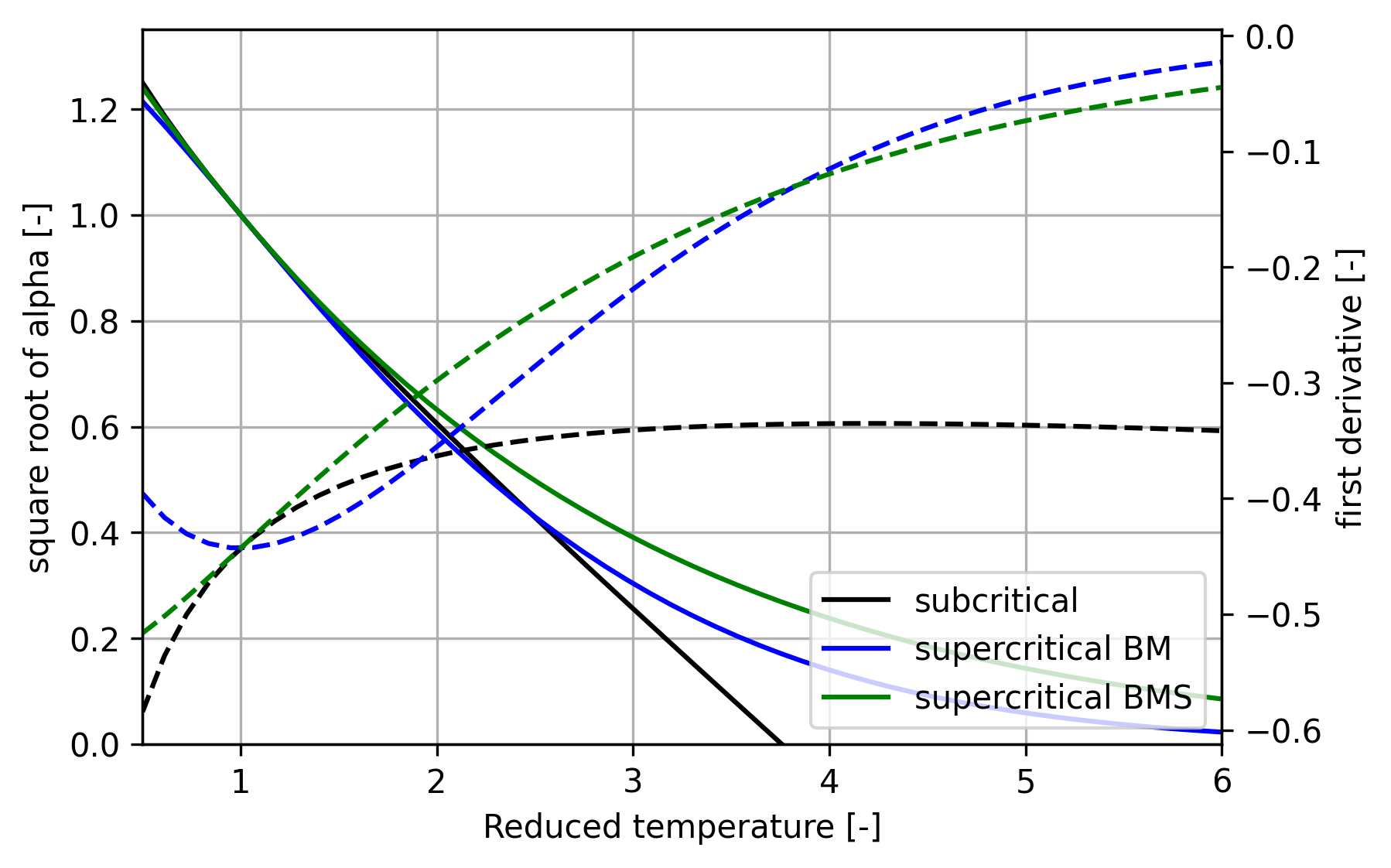
Already the original function [BM80] assumes the correct function value (unity) and first derivative at \(\tau = 1\), but the second derivative is not smooth originally, but zero at \(\tau = 1\). The extrapolation by [BM80] was developed for the standard SRK model (\(\eta = 0\)), for which the curvature is zero at \(\tau = 1\). The authors then correctly set the derivative to zero based on this fact. No further intention in doing so has been documented.
Three years later, when [Mat83] publishes the extended alpha-function for polar substances, the correction in the extrapolation was only done to refit the first derivative. The curvature however, now having the value \(-4\eta\), was ignored [Aspen Technology, Inc.01].
Note
While the sub-critical \(\alpha\)-function fits VLE data, it does not impact the quality of volumetric predictions that generally have a much larger error than the uncertainty caused by the \(\alpha\)-function. For practical reasons it is therefore most important to use a differentiable extrapolation that is physically sound than to try to fit this branch to volumetric data.